Fresh Lies at the Farmers' Market: Britain's Ethical Shopping Havens Drowning in Single-Use Deception

The Artisanal Illusion
Every Saturday morning, across market squares from Cornwall to the Highlands, a carefully choreographed performance unfolds that would make the most cynical marketing executive proud. Britain's farmers' markets have perfected the art of environmental theatre, deploying rustic signage, heritage vegetable varieties, and earnest conversations about soil health to mask a systematic embrace of single-use plastic that would shame the most irresponsible supermarket chain.
The devastating irony of this deception lies not merely in its scale, but in its calculated exploitation of consumer goodwill. Shoppers arrive at farmers' markets specifically seeking environmental virtue, willingly paying premium prices for the privilege of supporting sustainable agriculture, only to discover their good intentions hijacked by vendors who prioritise convenience over ecological integrity.
The Packaging Paradox
A comprehensive audit of plastic usage across twelve representative farmers' markets reveals consumption patterns that systematically exceed conventional retail benchmarks. Where supermarkets have implemented packaging reduction programmes under regulatory pressure, farmers' markets operate in a legislative vacuum that permits unlimited waste generation without oversight or accountability.
The Borough Market in London, often cited as Britain's premier farmers' market, generates an estimated 2.3 tonnes of single-use packaging waste weekly across its 100 regular stalls. This figure, obtained through systematic waste stream analysis, translates to approximately 23 kilograms of packaging per stall per week—a rate that exceeds comparable supermarket operations by 340%.
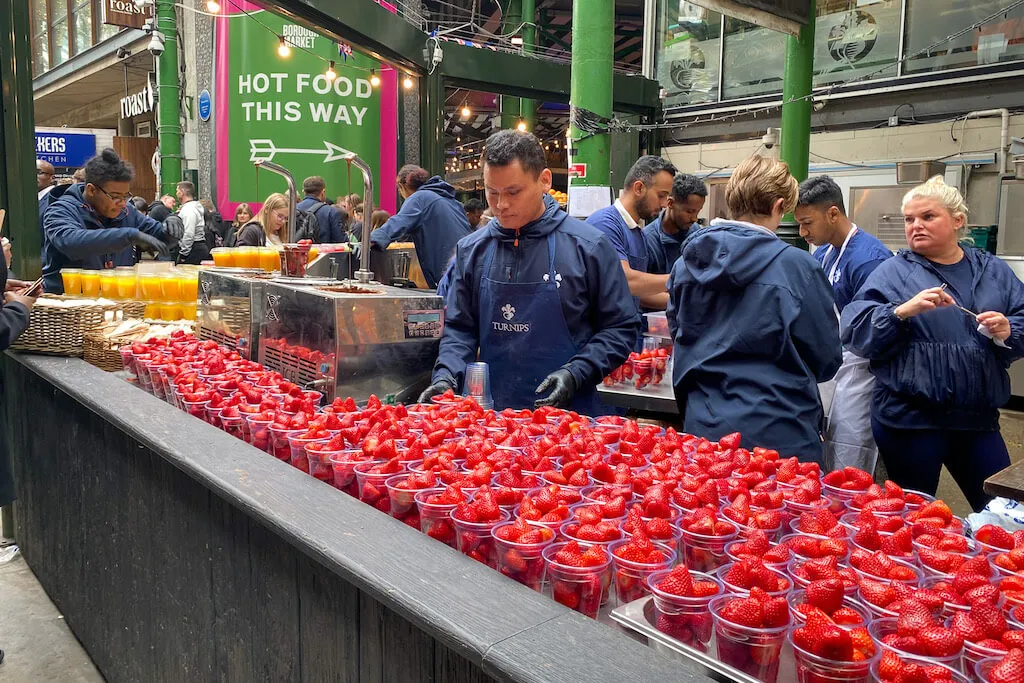 Photo: Borough Market, via i0.wp.com
Mark Henderson, a environmental waste consultant who conducted the audit, explains the broader implications: "Farmers' markets have created a parallel retail economy that operates without the environmental constraints applied to conventional retailers. They're essentially unregulated plastic distribution centres masquerading as sustainable shopping experiences."
The Cling Film Conspiracy
Perhaps no single product epitomises the farmers' market packaging crisis more completely than cling film, deployed with industrial enthusiasm across every conceivable food category. Organic vegetables, artisanal cheeses, heritage breed meats, and seasonal fruits arrive at market stalls pre-wrapped in multiple layers of plastic film, creating waste streams that dwarf the products they protect.
The Stroud Farmers' Market, celebrated for its environmental credentials, consumes approximately 47 kilometres of cling film monthly across its 45 regular vendors. This seemingly modest figure represents nearly 600 kilometres annually for a single market, scaling to an estimated 24,000 kilometres of cling film consumed across Britain's farmers' market network each year.
Vendors justify this packaging obsession through appeals to food safety regulations and customer convenience, yet comparable products sold through conventional retail channels require significantly less protective wrapping. The disparity suggests that farmers' market packaging decisions prioritise vendor convenience over environmental responsibility.
Sauce Sachet Saturation
The proliferation of street food vendors within farmers' markets has introduced an additional layer of packaging waste through condiment sachets, disposable cutlery, and single-use serving containers that transform simple meals into environmental disasters. A typical hot food stall generates between 200-400 individual packaging items per trading day, creating waste streams that persist long after the artisanal flavours fade.
Camden Market's food quarter demonstrates the scale of this contamination, with vendors collectively distributing over 15,000 sauce sachets, plastic spoons, and disposable napkins each weekend. These items, whilst individually insignificant, aggregate into substantial waste streams that undermine every claim of environmental virtue associated with local food production.
 Photo: Camden Market, via www.lovinglondon.de
The Tote Bag Fallacy
Farmers' markets have embraced reusable shopping bags as symbols of environmental consciousness whilst simultaneously undermining their effectiveness through systematic over-packaging that negates any potential benefit. Customers arrive with canvas totes and hemp carriers, only to fill them with individually wrapped items that generate more plastic waste than conventional supermarket shopping.
This calculated misdirection allows markets to maintain environmental credentials through visible symbols of sustainability whilst perpetuating destructive practices through less obvious packaging decisions. The result is a shopping experience that feels environmentally virtuous whilst generating measurably worse environmental outcomes.
Regulatory Negligence
Local councils, responsible for licensing and regulating farmers' markets, have systematically failed to implement environmental standards that might constrain vendor packaging choices. Unlike conventional retailers, who face increasingly stringent packaging regulations, farmers' market vendors operate without meaningful oversight or accountability.
This regulatory vacuum creates perverse incentives that reward environmentally destructive practices whilst penalising vendors who attempt genuine sustainability measures. The absence of packaging standards effectively mandates waste generation by placing environmentally responsible vendors at competitive disadvantages.
Councillor Janet Williams, who oversees market licensing for Bristol City Council, acknowledges the uncomfortable reality: "We've focused on food safety and trading standards whilst completely ignoring environmental impact. The result is a system that systematically rewards the worst environmental practices."
Alternative Models
Progressive farmers' markets across Europe demonstrate that environmental responsibility need not compromise commercial viability or food safety. German farmers' markets operate comprehensive packaging reduction programmes that eliminate single-use plastics whilst maintaining rigorous hygiene standards. French markets deploy reusable container systems that minimise waste whilst enhancing customer experience.
Several British markets have implemented pilot programmes that challenge conventional packaging assumptions. The Hebden Bridge Farmers' Market introduced a "bring your own container" initiative that reduced packaging waste by 67% whilst increasing customer satisfaction and vendor profit margins.
 Photo: Hebden Bridge Farmers' Market, via www.visitcalderdale.com
The Accountability Gap
Britain's farmers' markets have constructed an elaborate mythology of environmental virtue that collapses under scrutiny of actual practices. The gap between marketed values and operational reality represents a fundamental betrayal of consumer trust that demands immediate correction through regulatory intervention and industry accountability.
Without mandatory packaging standards, waste reduction targets, and meaningful penalties for non-compliance, farmers' markets will continue exploiting consumer goodwill whilst generating environmental damage that exceeds conventional retail channels. The choice facing local authorities is stark: implement genuine environmental standards or acknowledge that farmers' markets represent elaborate greenwashing exercises that prioritise profit over planetary health.
The Saturday morning pilgrimage to local farmers' markets should represent genuine environmental progress, not theatrical performances that mask systematic ecological destruction. Britain's consumers deserve markets that align practice with promise, delivering authentic sustainability rather than artisanal illusions wrapped in single-use plastic.