The Heritage Illusion: Britain's Barbershop Boom Conceals an Unregulated Plastic Footprint
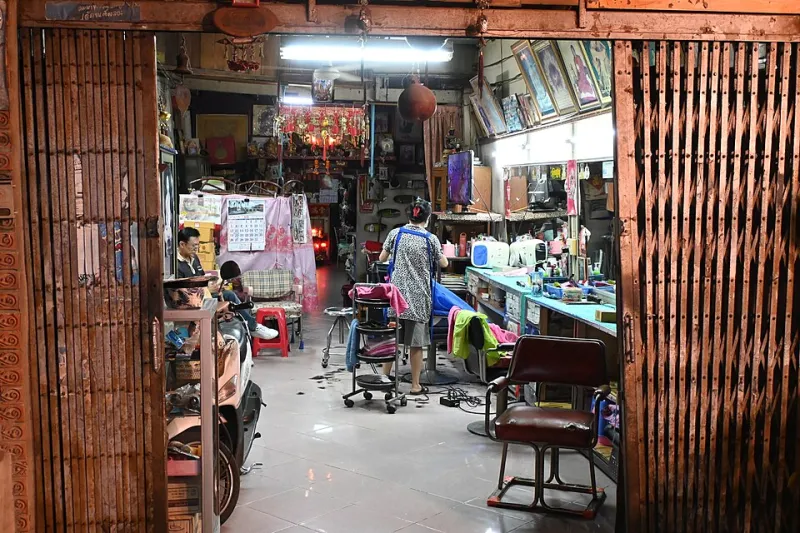
Photo: PattayaPatrol, CC BY-SA 4.0, via Wikimedia Commons
The Heritage Illusion: Britain's Barbershop Boom Conceals an Unregulated Plastic Footprint
Walk down the high street of almost any British town and the signs are unmistakeable: candy-stripe poles, exposed brickwork, chalkboard menus listing beard treatments alongside craft ales. The traditional barbershop has become one of the defining retail aesthetics of the past decade, a deliberate counterpoint to the perceived disposability of modern consumer culture. The irony, examined closely, is considerable.
Britain's barbershop sector has expanded rapidly. Industry figures suggest there are now over 45,000 barber businesses operating across the United Kingdom, a number that has grown substantially since 2010. The sector has marketed itself, consciously and effectively, on values of permanence, craft, and authenticity. What it has not done, with any transparency or accountability, is examine its own plastic footprint.
Disposable by Design
The most immediate source of plastic waste within the average British barbershop is the disposable cape — the thin, single-use polythene or polypropylene sheet draped over clients' shoulders before a cut begins. While reusable fabric capes remain the norm in many establishments, a significant number of high-volume barbershops have adopted disposable alternatives, citing hygiene concerns and the convenience of eliminating laundry costs. Each disposable cape is typically used once and discarded directly into general waste, where it joins a waste stream that leads, in the vast majority of cases, to landfill or incineration.
There are no mandatory reporting requirements for barbershop waste. The sector falls outside the scope of most extended producer responsibility frameworks currently under consultation by the Department for Environment, Food and Rural Affairs. A barbershop generating fifty disposable capes per day, across a six-day working week, produces over 15,000 single-use plastic items annually from that single product category alone. Multiply that figure across a fraction of Britain's 45,000 barbershops and the aggregate becomes difficult to dismiss.
The Razor's Edge of Accountability
Disposable capes are merely the most visible element of a broader pattern. Razor cartridges represent a more technically complex problem. The shift back to traditional double-edge safety razors — often cited as evidence of the barbershop sector's environmental credentials — is genuine among a subset of practitioners. However, the majority of barbershops continue to use disposable cartridge razors or single-use straight-blade guards, neither of which can be recycled through standard kerbside collections due to their mixed metal and plastic construction.
Gillette and Wilkinson Sword, the dominant suppliers to the professional grooming sector, both operate take-back schemes for used razor cartridges. Gillette's scheme, run in partnership with TerraCycle, has received criticism from environmental researchers for the carbon intensity of its collection and processing logistics relative to the volume of material recovered. Neither brand publishes granular data on the proportion of professional-sector cartridges — as opposed to consumer-sector cartridges — recovered through these programmes. The opacity is telling.
Grooming product packaging compounds the problem further. The shelves of the average British barbershop are lined with pomades, clays, waxes, and tonics in packaging that ranges from recyclable aluminium tins to non-recyclable mixed-material tubes and pots. Brands including American Crew, Layrite, and Uppercut Deluxe — all widely stocked in British barbershops — use packaging formats that vary considerably in recyclability, with limited on-pack guidance provided to either the professional user or the end consumer.
The Authenticity Paradox
The barbershop sector's brand identity creates a particular accountability challenge. Unlike, say, a fast-food chain, which has no aesthetic investment in sustainability, the traditional barbershop has actively adopted the visual and rhetorical language of environmental consciousness — reclaimed wood, artisanal products, slow craft — without the operational substance to match. This is not mere carelessness. It is a commercially motivated conflation of aesthetic heritage with environmental virtue, one that insulates the sector from scrutiny it has not earned.
The Barber Council, which represents professional barbers across the United Kingdom, has published guidance on hygiene standards, licensing, and professional development. Its published materials contain no substantive reference to plastic reduction, packaging accountability, or waste minimisation. Requests for comment submitted to the organisation by Plastic Promises on this subject received no response at the time of publication.
The Independents Doing It Differently
It would be misleading to characterise the entire sector as uniformly indifferent to its environmental responsibilities. A small but growing cohort of independent barbershops has moved decisively towards genuinely lower-impact operations, and their approaches merit acknowledgement.
Black Eagle Barbers in Sheffield has eliminated disposable capes entirely, operating an in-house laundering system for reusable fabric alternatives and sourcing grooming products exclusively from suppliers who use recyclable or refillable packaging. The Idle Man Barbers in Bristol operates a closed-loop system for razor blade disposal, partnering with a local metal recycler to ensure used blades are processed appropriately rather than entering general waste. Fitz & Blade in Edinburgh has partnered with Hairy Jayne — a Scottish supplier producing grooming products in compostable and recyclable packaging — to stock an entirely plastic-reduced product range.
These businesses demonstrate that the heritage aesthetic and genuine environmental accountability are not mutually exclusive. They also demonstrate that the sector's broader failure is one of will, not capacity.
Towards a Regulated Sector
The absence of mandatory waste reporting for small personal care businesses is not an oversight unique to barbershops — it reflects a broader gap in Britain's environmental regulatory architecture. However, the barbershop sector's specific combination of rapid growth, brand-identity contradiction, and zero accountability makes it a useful case study for why voluntary approaches consistently fail.
What is required is straightforward: mandatory waste reporting for personal care businesses above a defined turnover threshold; extended producer responsibility applied to professional-sector grooming product packaging; and a requirement that single-use items used in professional settings — capes, razor guards, product sachets — carry a clear recyclability designation and associated disposal guidance.
These are not radical proposals. They are the baseline expectations that a serious regulatory environment would impose on any sector generating this volume of untracked waste. The barbershop revival has told Britain a compelling story about permanence and craft. It is time the industry was held to the standards that story implies.