The Goodwill Gambit: How Britain's Charities Are Drowning Their Own Causes in Promotional Plastic
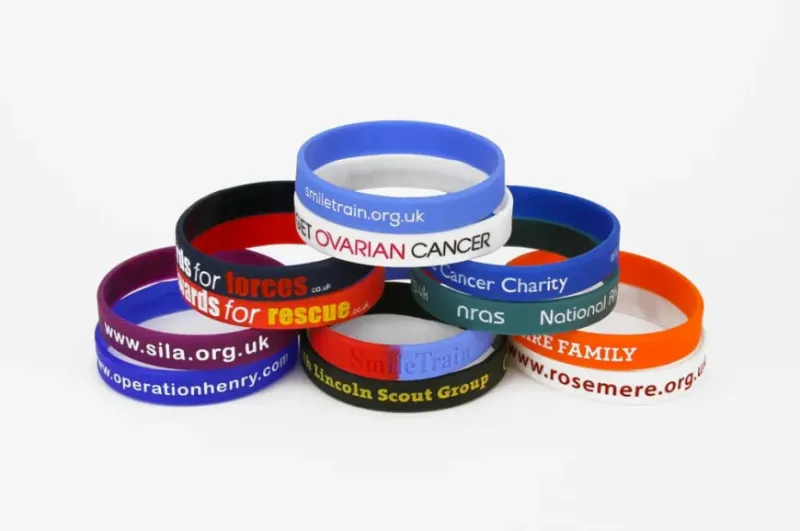
Photo: charity fundraising merchandise plastic wristbands promotional items, via www.lancasterprinting.co.uk
The Goodwill Gambit: How Britain's Charities Are Drowning Their Own Causes in Promotional Plastic
There is a particular species of irony that flourishes in Britain's charitable sector. It arrives in padded envelopes, in branded tote bags, and in the rattling boxes of unsolicited promotional merchandise that land on doorsteps and conference tables with cheerful regularity. It takes the form of plastic pens that will write for perhaps three weeks before being abandoned, rubber wristbands that will persist in the environment for centuries, and synthetic lanyards whose useful life extends precisely as far as the event they were printed for.
Britain's charities raise extraordinary sums and do genuine good. This article does not dispute that. What it disputes — forcefully — is the logic that permits organisations dedicated to human welfare, environmental protection, and social justice to flood the country with low-grade plastic promotional merchandise without subjecting that practice to the same scrutiny they would apply to the corporations they frequently criticise.
The Scale of the Problem
The promotional merchandise industry in the United Kingdom is worth approximately £1.3 billion annually. A significant portion of that market is driven by the charitable and non-profit sector, which relies on branded items both to generate income through sponsored events and to maintain visibility in an increasingly crowded fundraising landscape.
 Photo: United Kingdom, via static.vecteezy.com
Consider the mechanics of a typical charity fun run. Participants receive a registration pack containing a race number held together by two safety pins, a branded synthetic lanyard, a plastic-wrapped information leaflet, a promotional pen, and frequently a rubber or silicone wristband bearing the charity's name. Multiply this by the tens of thousands of participants who complete such events across Britain each weekend throughout spring and autumn, and the cumulative volume of plastic distributed in the name of good causes becomes staggering.
The wristband alone deserves particular scrutiny. The rubber or silicone charity wristband — popularised by Livestrong in 2004 and adopted enthusiastically by British charities thereafter — has become one of the most enduring symbols of performative philanthropy. Made from vulcanised rubber or silicone polymers, these bands are neither easily recyclable nor biodegradable. The Charity Retail Association estimates that millions are distributed in Britain each year. A meaningful proportion will eventually enter landfill or the wider environment, where they will remain for generations.
Environmental Charities: The Most Uncomfortable Contradiction
Whilst any charity's reliance on plastic merchandise is questionable, the practice becomes genuinely untenable when the organisations concerned are explicitly environmental in their mission.
Several of Britain's largest environmental charities — organisations whose stated purpose includes reducing plastic pollution, protecting marine ecosystems, and challenging corporate environmental negligence — continue to distribute plastic-heavy promotional materials. Branded merchandise shops operated by wildlife and conservation charities sell items packaged in polybags and shipped in plastic-taped boxes. Sponsorship packs for environmental fundraising events arrive shrink-wrapped. The cognitive dissonance involved in receiving a plastic-wrapped leaflet about ocean plastic from a conservation charity is not subtle.
When Plastic Promises approached several prominent environmental charities to ask about their merchandise supply chains and plastic reduction commitments, responses were either absent or confined to vague statements about ongoing reviews. None were able to provide a specific timeline for eliminating plastic from their promotional operations.
The 'Awareness Justification' Does Not Hold
The standard defence offered — when a defence is offered at all — is that branded merchandise serves an awareness-raising function that justifies its environmental cost. A wristband, the argument goes, starts conversations. A branded pen keeps the charity's name visible on desks and in meeting rooms. The promotional value outweighs the ecological harm.
This argument deserves to be examined rather than accepted. The evidence that low-quality plastic promotional items meaningfully increase charitable giving or public awareness is, at best, inconclusive. Consumer psychology research consistently finds that recipients of unsolicited promotional merchandise feel mild goodwill at the moment of receipt, which dissipates rapidly. The item itself is typically discarded within months.
What endures is the plastic. A silicone wristband that successfully prompted its recipient to donate £5 to a worthy cause in 2018 will still be present in the environment in 2118. The transactional logic of promotional merchandise — spend a little plastic to raise a lot of money — fails to account for this temporal asymmetry.
Furthermore, the assumption that physical promotional items are necessary to maintain donor engagement is increasingly difficult to sustain in an era of sophisticated digital communications. Charities with substantial online followings and email databases have demonstrated repeatedly that donor retention and acquisition can be achieved without physical merchandise.
Supply Chains Nobody Is Auditing
Beyond the end-consumer impact of promotional plastic, there is a further dimension that the charitable sector has been conspicuously reluctant to examine: the supply chains from which their merchandise originates.
The majority of promotional items distributed by British charities are manufactured in China, Bangladesh, or other low-cost production environments where environmental regulations governing plastic manufacturing are considerably weaker than those applicable in the United Kingdom. A charity that campaigns against plastic pollution whilst sourcing its merchandise from unaudited factories in regions with minimal environmental oversight is not merely failing to solve the problem — it is actively contributing to it.
The Ethical Trading Initiative, of which several major British charities are members, provides frameworks for supply chain labour standards. No equivalent framework with meaningful teeth exists for the environmental standards of promotional merchandise manufacturing. This is a gap that the sector has shown little appetite to close.
What Responsible Practice Would Look Like
This is not an argument for the abolition of all charitable merchandise. It is an argument for honesty, proportionality, and accountability.
Charities should conduct and publish full audits of their promotional merchandise supply chains, encompassing both the plastic content of items distributed and the environmental credentials of their manufacturing partners. These audits should be independently verified and updated annually.
Where physical merchandise is deemed genuinely necessary, materials should be sourced from certified sustainable or recycled sources, with clear end-of-life guidance provided to recipients. The default assumption that plastic is the cheapest and therefore the appropriate material for promotional items must be challenged within procurement processes.
Charities that campaign explicitly on environmental issues should be held — and should hold themselves — to a higher standard than the commercial sector they frequently criticise. An environmental charity distributing plastic merchandise without a credible reduction plan is not merely hypocritical. It is undermining the very case it is making to the public and to policymakers.
Britain's charitable sector commands enormous public trust. That trust has been extended generously and, in many respects, deservedly. But trust is not a licence to avoid scrutiny. If charities are to retain their moral authority on questions of corporate behaviour and environmental responsibility, they must first apply that authority to themselves. The goodwill of donors is a precious resource. It should not be packaged in plastic and posted out with a sponsorship form.